
A crane on the calendar is not a lift on the calendar. The crane is the machine. The lift is the job, and the job takes far more than the machine alone.
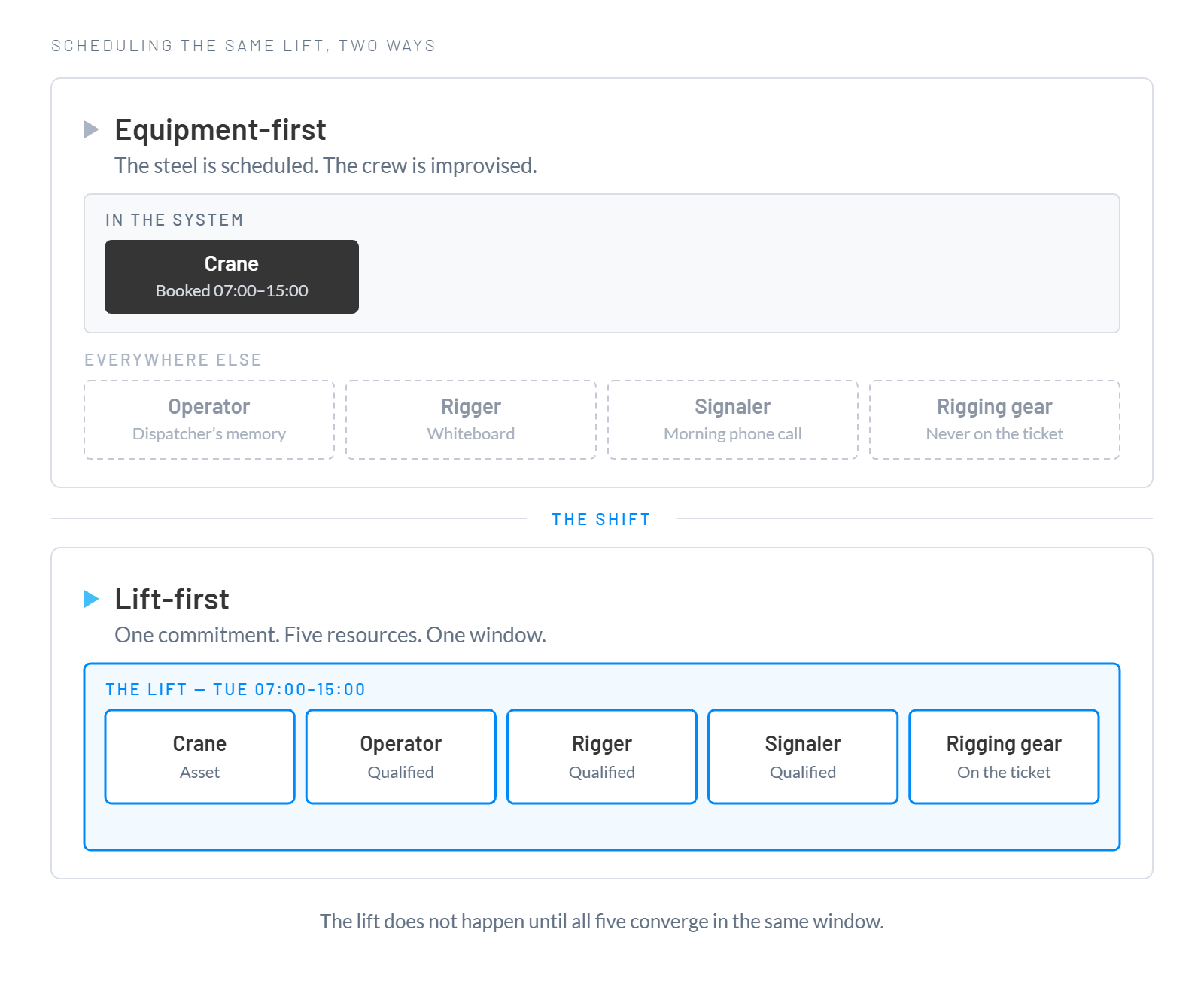
That distinction is where most crane rental operations quietly lose time, margin, and credibility, and it is the gap that crane crew scheduling software exists to close. The asset is visible. It has a number, a location, a rate, and a slot in the system. The people who make that asset productive, the operator, the rigger, the signaler, sometimes a second operator or a pilot car, live somewhere else: in a dispatcher’s head, on a whiteboard, or in a chain of early-morning phone calls. The steel is scheduled. The crew is coordinated. Those are not the same thing, and the gap between them sets the real timeline of every project.
This is equipment-first scheduling, and it is the structural problem behind most crane delays that have nothing to do with the crane.
Equipment-first scheduling: the steel is booked, the crew is improvised
Most rental platforms were built to schedule equipment. A crane is treated as a single line: one asset, one window, one rate. But a lift is a multi-resource commitment. It does not happen until a qualified operator, the correct rigging crew, the right signaler, and the necessary ancillary gear converge on the same job in the same window, and every one of those roles carries its own qualification, availability, and cost.
When the asset is tracked in software and the crew is tracked by memory, the work is only half scheduled. The crane shows available; whether the lift can proceed is a separate question no one can answer from the system.
In a recent demo with a crane and heavy-lift rental operation, the first thing their crane lead wanted to understand was not how the platform books a machine, it was how it handles operated equipment: how the people get scheduled, qualified, and billed alongside the asset. That instinct is correct. For heavy lift, the crew is the harder half of the problem.
Why the crew problem keeps getting harder
Three forces are tightening the squeeze.
The qualified-operator shortage is real and worsening. Certified crane operators are aging out faster than they are being replaced, and certification is not optional, it is a regulatory and insurance requirement. That makes the operator, not the crane, the true constraint on how many lifts a company can commit to.
Schedules are compressing. General contractors expect lifts to land in narrow windows. A crane that arrives without its full qualified crew is not early. It is idle, on the clock, and generating a dispute instead of revenue.
Margins leave no room for waste. Every hour an operator spends traveling to the wrong site, waiting on standby, or sitting unassigned is unproductive, non-billable time, what the industry calls white space. A handful of those hours each week is the difference between a profitable branch and a break-even one.
What equipment-first scheduling actually costs
The costs are not abstract. A double-booked operator means a lift slips, and a slipped lift can stall an entire site for a day. A crew dispatched without confirmed qualifications is a safety exposure and a liability the moment something goes wrong. Rigging and ancillary gear that never made it onto the ticket is margin that quietly disappears. Operator travel and standby hours that go uncaptured are revenue earned and never billed.
There is a human cost as well. The dispatcher who holds the entire schedule in memory is one sick day away from a crisis. The knowledge of who is qualified for what and who works well together lives in a few people, and it walks out the door when they do.
The shift: schedule the lift, not the asset
The fix is to stop scheduling cranes and start scheduling lifts, to treat the operator, the crew, the gear, and the machine as one connected commitment, not four separate ones. This is what crane crew scheduling software is built to do, and where RentalResult helps.
RentalResult treats a crane as operated equipment. A company can rent it bare, or rent it with an operator and bill it accordingly, either at a base rate for the machine or by operator hours captured from timesheet data, including travel time, working time, standby time, and overtime. The crew is not an afterthought to the rental. It is part of it.
The labor allocation screen makes the multi-role problem visible. It is a calendar you can view by day, week, or month, and flip between two perspectives: every job that needs labor and who is assigned to it, or every operator and what they are committed to. Assigning a crew is drag and drop. Most important, selecting a piece of work narrows the list to qualified operators only, so a signaler, a rigger, or a crane operator surfaces for a lift only when they carry the qualification it requires. Compliance becomes a scheduling input, not a paperwork check after the fact.
And it all lives in one operational view. Dispatch works from a single pane of glass, the logistics control center, where the crane, the crew assignment, the ancillary gear, and the delivery move together. There is no separate spreadsheet for labor and no separate phone tree for the crew.
Building crane crew scheduling into the workflow
Five operational habits separate the operations that lift on time from the ones that scramble.
- Schedule the crew with the crane, never after it. Treat a lift as committed only when the qualified operator and the full crew are confirmed for the same window. An available machine with an unconfirmed crew is not a booking. It is a hope.
- Make qualifications a scheduling input. Stop verifying certifications as a separate step after the assignment. Build them into the moment of assignment, so an unqualified person cannot be scheduled to a lift in the first place.
- Book the gear and the hours, not just the machine. Tie rigging and ancillary equipment to the job at the point of scheduling, and capture operator travel, working, standby, and overtime hours in the same record, so nothing falls off the invoice.
- Give dispatch one view of crane and crew. Coordinate both from the same screen. The moment labor lives in a different system than equipment, the gap reopens.
- Measure white space, not just utilization. Track the unproductive, non-billable hours operators spend traveling, waiting, and sitting unassigned. That number, more than raw utilization, is where margin is won or lost.
Why your schedulers push back, and why the shift serves them
The people most likely to resist are the best dispatchers and crane coordinators, and their hesitation is earned. They have run this by phone and instinct for years, and they are good at it. A new system can feel like a verdict on hard-won expertise.
The reframe is simple. The system does not replace their judgment. It protects it. Today, the knowledge of who is qualified, who is available, and who works well together is trapped in one person’s memory, so that person can never be sick, never take a real vacation, and always carries the blame when a lift slips. A shared view does not take their expertise away. It makes their expertise the operation’s, instead of a single point of failure. It ends the early-morning scramble, and it is the difference between being indispensable and being trapped.
For operations and project leaders
Your competitors are not winning more crane work because they own better steel. The advantage goes to the operation that can confirm, in seconds, that a qualified crew and the right gear are aligned to a job, and then bill every hour of it cleanly. The lift was never the hard part. The coordination around it always was.
Schedule the crew, and the cranes take care of themselves.
RentalResult brings crane scheduling, qualified crew allocation, and operated-equipment billing into one connected workflow, so the people, the gear, and the machine stay aligned on every lift.
See how RentalResult handles qualified crew scheduling and operated-equipment billing for crane rentals. Request a demo.