
The jobsite says it sent the generator back three weeks ago. The yard says it never arrived. The project keeps paying for it on the on rent report, and the superintendent is furious. Then someone walking the back of the warehouse finds it on a shelf, tagged and clean, where it has been sitting since March.
Every equipment leader has a version of this story. The usual response is to find out who dropped the ball, have a hard conversation, and send a reminder email about return procedures. A month later, it happens again with a different item and a different person.
That pattern is not a people problem. It is a process problem, and a management thinker proved it with a bowl of plastic beads more than 40 years ago. For any contractor running internal equipment rental, his experiment explains why return errors keep coming back, and what actually makes them stop.
The short answer
The red bead experiment shows that most errors come from the system, not the worker. Contractors reduce equipment return errors by fixing five handoffs: pickup, the truck, the landing zone, check in and the billing stop. The most effective moves are a weekly on rent report confirmed by each superintendent, a marked return landing zone, driver owned check in, and digital signatures at delivery and pickup.
In this article
- What the red bead experiment proves
- The five handoffs where equipment returns go wrong
- Why a weekly on rent report beats a monthly one
- Design a return landing zone
- Make the driver own check in
- Getting field adoption when you are not the field’s boss
- Remove paper from delivery and return sign off
- Where RentalResult fits
- Frequently asked questions
What the red bead experiment proves
W. Edwards Deming ran the red bead experiment in his management seminars for years. The setup is simple. A bowl holds thousands of beads, about four in five white and one in five red. Red beads are defects. A team of “willing workers” dips a paddle with 50 holes into the bowl, and each scoop is one day of production.
1 in 5
beads in the bowl are red. Red beads are defects.
50
holes in the paddle. Each scoop is one day of production.
0
red beads is the goal management sets, with praise, warnings and firings to enforce it.
Management sets a clear goal: zero red beads. Inspectors count every scoop. The best performers get praised. The worst get warned, put on probation, and eventually let go. Posters urge everyone to do their best.
None of it changes anything. Every worker pulls roughly the same share of red beads, day after day, because the red beads are in the bowl. The defect rate belongs to the system, not to the person holding the paddle. Rewarding one worker and firing another only rewards and punishes luck.
The defect rate belongs to the system, not to the person holding the paddle.
Deming’s point was blunt: most of the variation in results comes from the system that management designed. Workers can only perform as well as that system allows.
Now look at your yard. If equipment returns go wrong at a steady rate no matter who works the dock, you are looking at red beads.
The five handoffs where equipment returns go wrong
A return is not one event. It is a chain of handoffs between people who report to different managers, work on different schedules, and often never speak to each other. Every handoff is a place where the record and the real item can split apart. Here are the five that matter most.
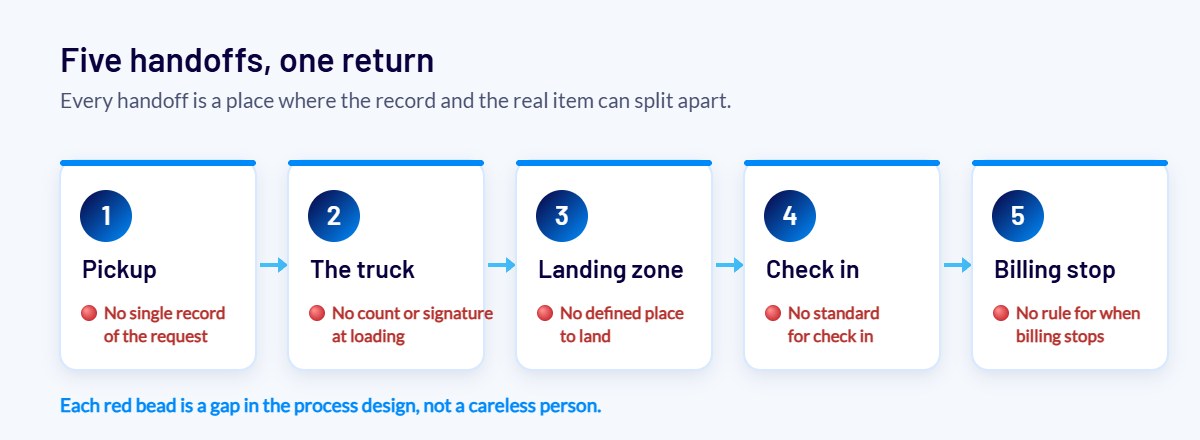
1
Pickup
The jobsite calls for a pickup, by phone, by text, or by telling a driver in person. The request lives in someone’s head or someone’s inbox. If it never becomes a record, the item stays on rent on paper while it sits by the jobsite trailer waiting for a truck. The project keeps getting charged, and the superintendent assumes the yard is padding the bill.
2
The truck
The driver loads what is there, which is not always what was requested. Three of four light towers are ready. A pallet of shoring has two extra frames from another job. Without a count and a signature at the point of loading, nobody can prove what left the site, and the dispute starts before the truck reaches the gate.
3
The landing zone
The truck arrives at the yard at 4:30 on a Friday. Nobody is at the dock, so the driver drops the load wherever there is room. Items from three jobs end up in one pile. Some get put away before anyone records them. This is how a generator ends up on a shelf since March.
4
Check in
Someone eventually works the pile. They match items to paperwork that may be on the clipboard, in the truck, or nowhere. Serial numbers get skipped when the tag is dirty. Bulk items get counted by eye. Damage gets noted on a sticky note, if at all. Every shortcut here becomes an error on someone’s job cost next month.
5
The billing stop
Even a clean check in can fail if it does not stop the rental charge on the right date. If the off rent date is keyed in days later, or set to the day of check in instead of the day of pickup, the project pays for days it did not use. That is the moment the field stops trusting the equipment company’s numbers.
Look at that list again. Not one of these failures requires a careless person. Each one comes from a gap in the design: no single record of the request, no proof at loading, no defined place to land, no standard for check in, and no rule for when billing stops. Those are red beads, and they are in your bowl.
Why a weekly on rent report beats a monthly one
Most contractors find return errors the hard way: at month end, when a project manager reads the equipment charges and pushes back. By then the trail is four or five weeks cold. The driver does not remember the load. The yard has received hundreds of items since. Nobody can say for sure whether the item came back, so someone splits the difference or writes off the charge.
A weekly on rent report changes the math. Send each project a list of what it has on rent every week, and ask the superintendent to confirm it. When a line is wrong, the trail is one week old. The driver remembers the trip. The landing zone has not been cleared. The fix takes ten minutes instead of a meeting.
Monthly reconciliation
- The trail is four or five weeks cold
- The driver does not remember the load
- Disputes end in a split or a write off
Weekly on rent report
- The trail is one week old
- The driver remembers the trip
- The fix takes ten minutes instead of a meeting
The weekly report also does something a once a year physical inventory count cannot. A physical inventory count tells you what is on the shelf on one day. It does not tell you which project has been paying for that shelf space, or for how long. The weekly report catches the gap while it is still small, and it turns every superintendent into a second set of eyes on the record.
There is a financial reason too. Your equipment company is measured on what it bills and what the projects trust. If you track the equipment spend capture rate, every disputed charge drags that number down and gives a project manager a reason to rent outside next time. Clean weekly reports protect the relationship that keeps work coming to the yard.
Design a return landing zone
The red bead lesson says to fix the bowl, not lecture the worker. In a yard, the bowl is the physical space where returns arrive.
A return landing zone is a marked area where every returning item goes first, before anything else happens. Nothing gets put away from the landing zone until it is checked in. A good one has:
- Lanes by load or by project, so items from different jobs never mix in one pile
- Clear signage and floor marking that a driver who has never been to this yard can follow
- A hold area for damaged or unidentified items, so they cannot drift into ready stock
- A rule that the zone is cleared every day, so nothing ages in it over a weekend
The landing zone costs paint, signs and discipline. It removes the single biggest source of “it is somewhere in the yard.”
Make the driver own check in
In most yards, the driver drops the load and leaves, and check in happens later by someone who was not there. That gap is where counts drift and damage goes unrecorded.
Flip it. The driver who picked up the load confirms the count at the jobsite and again at the landing zone, against the same list. If the counts match, check in starts from a verified record. If they do not, the discrepancy surfaces while the driver is still standing there, not three weeks later on a project manager’s desk.
This is not about adding work for drivers. It is about putting the check at the point where one person has seen both ends of the trip. The person with the most information makes the record.
Getting field adoption when you are not the field’s boss
Here is the hard part. The equipment team designs the return process, but most of the people who execute it do not report to the equipment team. Superintendents report to project managers. Foremen report to superintendents. Laborers loading a truck report to a foreman who is thinking about the pour tomorrow, not the light tower going back to the yard.
That is why reminder emails fail. The equipment team has responsibility for returns but no authority over the people making them.
The contractors who get this right do three things:
- Get a senior sponsor. An operations executive states, plainly and in public, that equipment returns follow the standard process. Without that, the equipment team is asking favors.
- Build an accountability chain. The superintendent owns the weekly on rent confirmation for the project. The foreman owns calling for pickup through the standard channel. Each person has one clear job, and each job rolls up to someone who can enforce it.
- Show the field what is in it for them. A clean return means the project stops paying for equipment it already sent back. Superintendents care about job cost. Frame the process as protection for their budget, not a chore for the yard.
Deming would recognize the pattern. When leadership changes the system and backs it, the same people produce different results.
Remove paper from delivery and return sign off
Paper is where proof goes to die. A delivery ticket signed on a tailgate gets wet, gets lost, or sits in a truck door pocket for two weeks. When a project disputes a charge, the yard has to find the ticket before it can defend the bill.
Digital sign off closes that gap. When the person on site signs on a phone at delivery and again at pickup, the signature is attached to the order the moment it is captured. There is nothing to file, nothing to scan and nothing to lose. A disputed charge becomes a lookup instead of a search.
The same logic applies to pickup requests. A request made by text or phone call depends on someone writing it down. A request made through a shared system is a record from the first second.
Where RentalResult fits
RentalResult is built for contractors who run equipment as an internal rental business. It connects the handoffs in one record, from the project’s request to the return on the rental contract.
- Pickup: Project teams put equipment off rent from the Job Site Portal equipment list, which raises a pickup ticket the yard can act on.
- The truck and sign off: Signatures captured on a mobile device at delivery and pickup are stored with the dispatch or pickup document, along with who signed and when.
- Check in: The return records each item’s status, flags items as lost, and captures damage notes with a charge.
- Weekly visibility: The Job Site Portal shows each project team what it has on rent, with estimated off rent dates the project can update as plans change.
- Billing stop: The return is created from the pickup and records the actual off rent date and time on the rental contract, so the job stops paying from a documented date.
That is the difference between construction equipment tracking software that tells you where an item is and a system of record that tells you who has it, who is paying for it, and when that stopped.
Your yard crew is not the problem. Your process is. Fix the bowl, and the red beads go away.
Most contractors track their equipment. The best run it like a business.
Find out where your process leaks
Download the Yard Handoff Audit, a 20 point checklist that scores your pickup, truck, landing zone, check in and billing stop handoffs, so you can see exactly where equipment and billing slip through.
Frequently asked questions
What is the red bead experiment?
The red bead experiment is a demonstration W. Edwards Deming used to show that most variation in results comes from the system, not the worker. Workers scoop beads from a bowl that is about one fifth red, and no amount of praise, pressure or firing changes how many red beads they pull.
How does the red bead experiment apply to construction equipment?
It explains why equipment return errors keep happening no matter who works the yard. If the process has no single record for pickup requests, no count at loading, no landing zone and no rule for when billing stops, errors are built in. Fixing the process removes them; blaming people does not.
How do contractors reduce equipment return errors?
Contractors reduce return errors by fixing five handoffs: pickup, the truck, the landing zone, check in and the billing stop. The most effective moves are a weekly on rent report confirmed by each superintendent, a marked return landing zone, driver owned check in, and digital signatures at delivery and pickup.
What is the difference between a physical inventory count and an on rent report?
A physical inventory count records what is in the yard on one day. An on rent report shows which project has each item and how long it has been charged. Contractors need both, but a weekly on rent report catches return errors while they are still easy to fix.
How often should contractors reconcile equipment on rent to their projects?
Weekly. A monthly reconciliation leaves the trail four or five weeks cold, so disputes end in write offs. A weekly confirmation by each superintendent catches mistakes while drivers and yard staff still remember the trip.
Who should own equipment returns on a jobsite?
The superintendent should own the weekly on rent confirmation, and the foreman should own requesting pickups through the standard channel. A senior operations leader should sponsor the process so the equipment team is not relying on favors from people who do not report to it.